Article
From reform to reality: Creating opportunity at the state and local level with the new FEMA recommendations

The recent recommendations from the FEMA Review Council report are having a major impact on every person involved in emergency management. More than a policy change, these recommendations represent an operational shift for locally-executed, state-managed, and federally-supported disaster response.
For state and local emergency management agencies, success will depend on how jurisdictions can scale up the workforce, processes and partnerships needed to take on a larger role and greater responsibilities.
Those that respond now will be better prepared to adapt.
Shifting responsibilities and expectations
The proposed reforms will reshape how emergency management functions across all levels of government. In practical terms, states will move from coordinating federal programs to designing and operating their own disaster programs, supported by federal funding and standards.
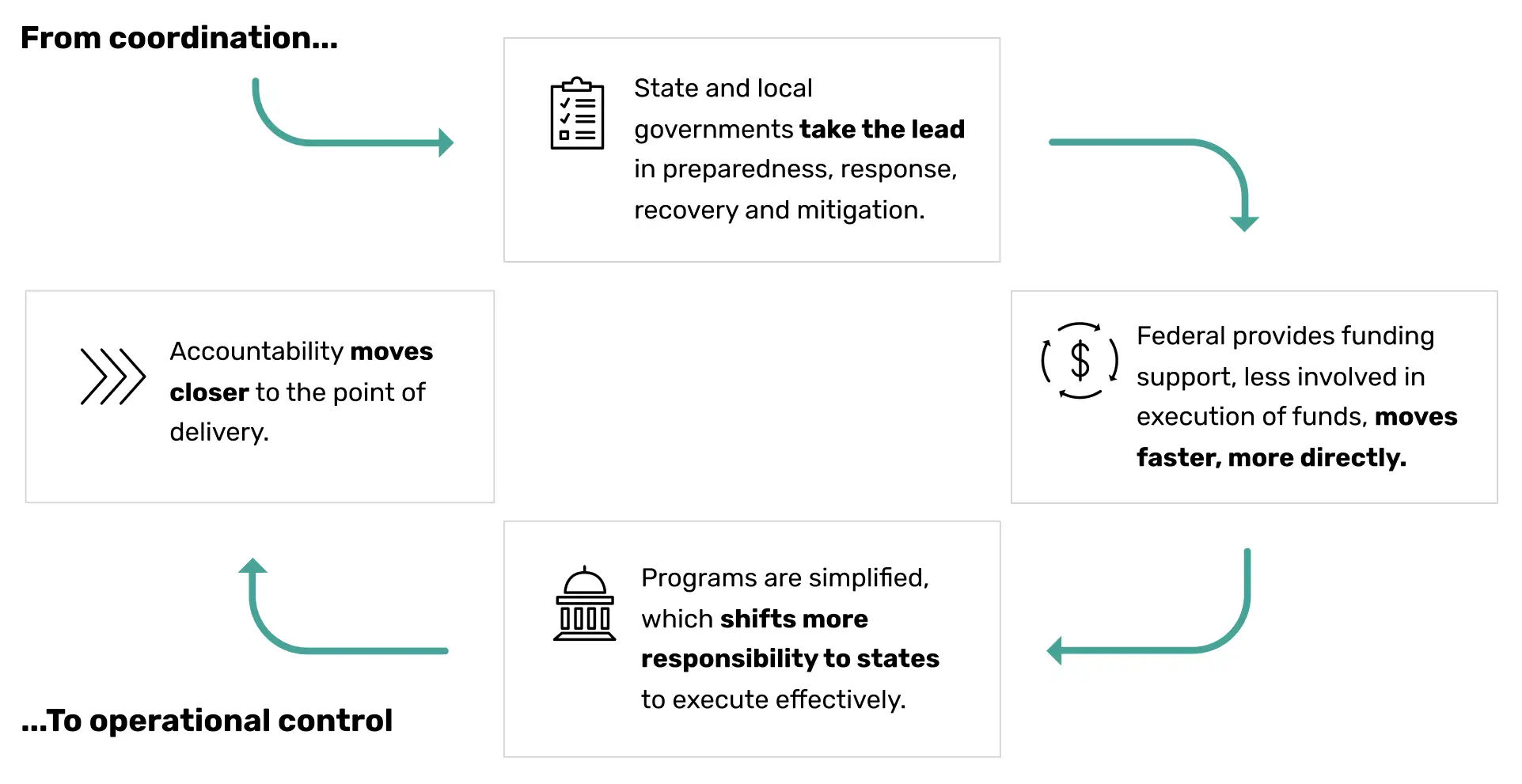
The goal of the reforms is to reduce complexity and speed up recovery. At the same time, this creates new demands and pressure on state and local agencies already stretched thin.
Addressing four implementation challenges
Overall, the FEMA Review Council recommendations present four significant challenges for state and local agencies:
1
Workforce and capability readiness
Many agencies lack the staffing models, training systems or leadership pipeline to scale under a more decentralized system. Making the transition will require putting people first.
That, in turn, requires strengthening emergency management agencies by understanding current strengths and gaps, as well as defining roles that align with expanded responsibilities of individuals. It also requires training and development pathways while preparing leaders to manage complex, multi-agency operations.
2
Program execution capacity
With this increasing focus on people comes greater responsibility for program execution. New approaches to disaster funding and recovery will require defined processes, governance, and coordination that are not yet in place in many states.
Agencies will need to prioritize:
- Defining clear processes for response, recovery, and mitigation.
- Setting up program management structures for major initiatives.
- Establishing governance that supports faster decision-making.
- Aligning efforts across state agencies and local partners
By moving away from ad hoc coordination towards repeatable processes, agencies can make a significant difference.
3
Stakeholder coordination
While the reforms emphasize a whole community approach, most jurisdictions lack strong frameworks for working with private sector, nonprofit and regional partners.
To improve coordination across partners, agencies need to define how different partners fit into the response and recovery efforts and set clear expectations and roles. They must also develop a network to share information quickly and include these partners in planning and exercise.
4
Communication and change management
Without clear channels of communication and change management strategies, shifts in roles and responsibilities – inside and outside the agency – can lead to confusion, questions of trust, and a rocky transition.
Effectively implementing reforms requires that new roles and expectations are communicated clearly and guidance is provided to all local partners. Change management must be a part of the implementation plan and align with your internal and external messaging.
Turning reform into results
The recommendations from the FEMA Review Council report create an opportunity to build a more responsive, locally-driven emergency management system. State and local governments that focus on their workforce as well as execution, coordination and communication will be better positioned to respond and recover more quickly.
Making that happen will require significant effort and support.
How Eagle Hill can help
Right now, Eagle Hill Consulting is working alongside emergency management agencies across the country, applying its experience and unconventional approach to consulting. Eagle Hill supports states and localities by:

Assessing workforce and credibility gaps and developing practical plans to strengthen staffing, training, and leadership

Designing and implementing program structures that enable agencies manage response and recovery efforts with clarity and consistency

Building coordination frameworks that bring together government, private sector, and nonprofit partners

Developing communication and change management approaches that support smooth adoption of new roles and responsibilities.
Eagle Hill’s unconventional approach is hands-on and tailored to each jurisdiction’s needs. If your organization is preparing for these changes or looking to strengthen your emergency management capabilities, our experienced experts welcome the opportunity to connect.