Article
The generational divide in today’s workforce is growing—and it’s a strategic opportunity for employers
Table of contents
Related services and insights
Talent strategyThe Eagle Hill Consulting Employee Retention Index

The latest Eagle Hill Consulting Employee Retention Index tells a story that goes beyond high retention. Yes, employees are staying put. But beneath that stability, a more consequential dynamic is emerging: a widening generational divide in how workers are experiencing today’s labor market.
Eagle Hill’s data shows a nearly 20-point gap in retention outlook between younger and older workers. Gen Z (113.6) and Millennials (113.7) are the most likely to stay in their roles over the next six months, while Gen X (95.6) and Baby Boomers (96.0) are showing increasing signs of attrition risk.
To better understand what’s driving this divide, we looked at how each generation is responding to the current environment:
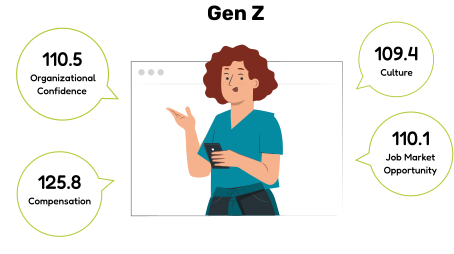
Gen Z sharply rebounded this period. After declining much of the last year, their Retention Index jumped 10.1 points, driven by gains across compensation, culture, and organizational confidence—even as optimism about external opportunities increased.
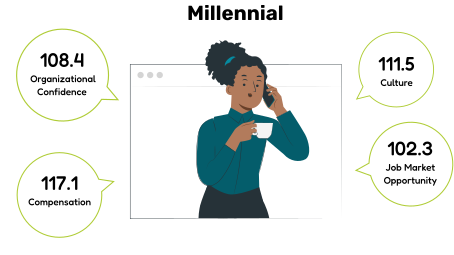
Millennials remain the most likely to stay, with the strongest views of workplace culture. However, early signs of attrition risk are emerging. Their Retention Index declined (-1.7) for the first time in a year, driven by falling compensation perceptions (-5.5) and weakening organizational confidence (-3.3).
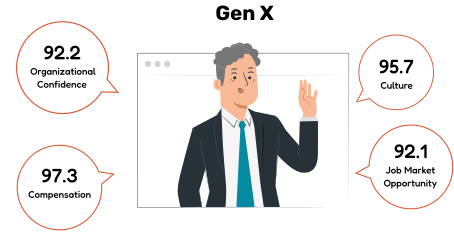
Gen X and Baby Boomers continue a downward trend. Their declining retention outlook is tied to weakening organizational confidence and deteriorating perceptions of workplace culture, even as views on compensation improved this period.

At first glance, these findings may seem counterintuitive. Younger workers have historically been more mobile, often changing jobs to accelerate growth and compensation. But today’s environment is different. A cooling job market and reduced external opportunities are encouraging early- and mid-career employees to stay where they are—for now.
For Gen X and Baby Boomers, the calculus appears to be shifting in the opposite direction. With more experience, financial stability, and in some cases greater flexibility, they may feel more confident making a change—or stepping away altogether. At the same time, declining organizational confidence across the workforce suggests that even those who stay may be questioning their long-term future.
This divergence is more than a demographic trend. It reflects fundamentally different expectations, motivations, and pressures at different career stages.
Younger employees are looking for growth, skill-building, and clear pathways forward. When those opportunities are not visible internally, their decision to stay may be driven more by caution than commitment. That creates risk: a workforce that appears stable but is quietly disengaging.
More experienced employees, meanwhile, are evaluating their options through a different lens. Many are seeking purpose, flexibility, and alignment with leadership. When those factors fall short, they may be more willing to leave—even in a less dynamic job market.
Turning generational divide into a workforce advantage
For employers, this moment presents both a challenge and an opportunity. The organizations that succeed will be those that move beyond one-size-fits-all talent strategies and take a more targeted, multigenerational approach to workforce management.
Here are four ways to leverage the current environment and shape a stronger, multigenerational workforce:
1
Double down on career mobility for younger talent. When external movement slows, internal mobility becomes critical. Creating clear pathways for advancement, stretch assignments, and skill development can help convert “staying” into meaningful engagement.
2
Engage experienced talent intentionally. Offer flexibility, tap into institutional knowledge, and create roles aligned with evolving career priorities. Retaining this group is not just about continuity—it’s about preserving leadership capacity and mentorship.
3
Use this period to rebalance the workforce. With fewer employees leaving, leaders have a rare window to assess talent, address skill gaps, and make more deliberate decisions about where to invest.
4
Prioritize communication and clarity. As organizational confidence declines, employees across generations are looking for direction. Leaders who clearly articulate strategy, priorities, and growth opportunities will be better positioned to build trust and retain the right talent.
The bottom line
The bottom line: today’s high retention environment is not a reason to stand still—it’s a window to act. The generational divide in the workforce is growing, and organizations that respond to it now will be best positioned to build a stronger, more resilient workforce for the future.