Article
The emergency management learning lifecycle: Developing people, driving readiness
Table of contents

Training emergency management professionals is critical to operational readiness in local jurisdictions. Yet tight budgets, staffing challenges, and the unpredictability of the work can make it hard to prioritize formal training. Agencies can change this by rethinking how training fits into operations.
The Emergency Management Learning Lifecycle is built for today’s operational realities. It is a cyclical, scalable, and competency-based model that goes beyond one-time instruction or occasional training events. It builds organizational muscle memory through continuous learning, guiding emergency management professionals through a lifecycle of learning activities that aligns with both agency needs and their career progression. The learning activities are informed by FEMA’s Emergency Management Development Continuum (EMDC) and the Emergency Management Professional Program (EMPP).
The Emergency Management Learning Lifecycle
A cyclical, scalable, and competency-based training model
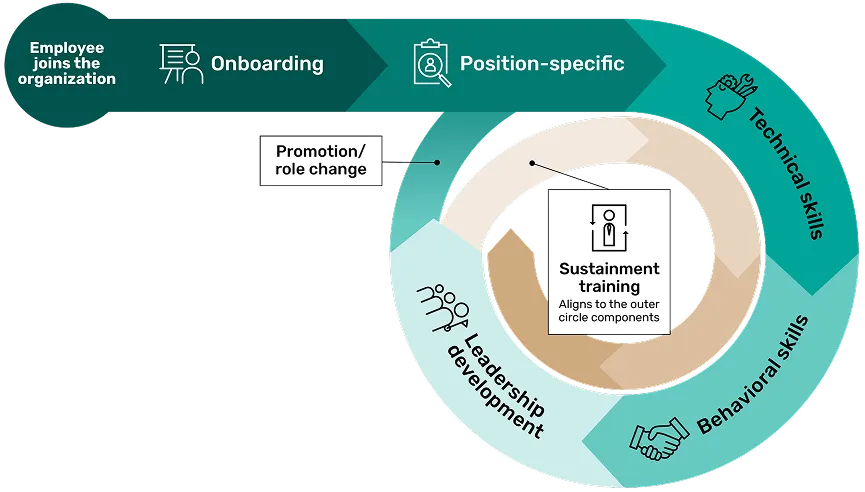
From onboarding to sustainment: Training across the employee journey

Onboarding and early-career training
Establish an understanding of the employee’s position within the agency and its broader mission.
Why it matters
Formal onboarding can accelerate new hires’ learning, improving their confidence and competence. This is critical because emergency managers must coordinate across multiple agencies and levels of government from day one. Structured onboarding also lays the foundation for position-specific learning. Improving onboarding and early-career training can boost retention too—well-prepared staff are more likely to feel confident and stay.
Address top pain points
- High turnover and knowledge loss
- Steep learning curve
- Small staff that make it hard to prioritize formal onboarding

Position-specific training
Define and strengthen comprehension of individual roles, responsibilities, and functional expectations.
Why it matters
By identifying distinct skills for different positions, agencies can target development where it’s needed most to improve competency. Position-specific training also helps with career progression. Employees understand what training or certifications will move them from an entry-level coordinator to an advanced emergency manager. This training addresses the mismatch where some staff are under-trained for critical functions while others sit through trainings not relevant to their actual duties.
Address top pain points
- Inconsistent requirements that create uneven skill levels
- Different needs across technical and non-technical roles
- Compliance doesn’t always create capability

Technical skills
Bridge skills gaps and reduce barriers to technology adoption and process changes across all levels of tech familiarity.
Why it matters
By investing in technical emergency management skills development, such as training in data analysis, GIS, emerging emergency management software, and basic coding for data management, agencies can better leverage tools that improve disaster response and recovery. Technical training can include both upskilling current staff and onboarding new talent with tech backgrounds. Closing the technology skills gap is key to help agencies move from manual, experience-based operations to data-informed, innovative practices.
Address top pain points
- Generational skills gap in technology
- Technology investments underutilized due to skills gaps
- Need for skills in cybersecurity and crisis communications via social media

Behavioral skills
Build the competencies required for operational effectiveness and interagency collaboration.
Why it matters
Disasters are chaotic, multi-agency events. An emergency manager’s effectiveness can hinge on skills like communication, decision-making under pressure, and the ability to coordinate diverse stakeholders. By incorporating emergency management behavioral-skills training that includes courses on crisis leadership, public speaking for emergency updates, negotiation, conflict management, and cultural competency, agencies can cultivate more well-rounded emergency managers who excel under pressure.
Address top pain points
- Training programs that don’t emphasize behavioral skills
- Interagency collaboration challenges
- Lack of training in stress management, which can lead to burnout

Leadership development
Prepare employees to support team members, assume greater responsibility, and progress into advanced roles.
Why it matters
Cultivating leaders smooths the transfer of institutional knowledge and improves preparedness. Some approaches include mentorship programs, leadership courses, and clear succession plans for key roles. Leadership development can start at any level and instilling leadership competencies at the individual contributor level better prepares employees for future growth opportunities. In a field where credibility and networks matter, investing in people’s leadership growth not only improves disaster outcomes but also supports retention.
Address top pain points
- Impending retirement wave
- Lack of formal leadership tracks
- Leadership pipeline and retention

Sustainment training
Reinforce and expand existing competencies to ensure continuous readiness and professional growth.
Why it matters
Sustainment takes training from a one-off, check-the-box task to a culture of continuous improvement through ongoing opportunities to build capability and keep skills sharp. Sustainment training offers teams a venue to refresh their skills, learn new best practices, or update key concepts or policy changes without rehashing entire curricula or courseware, ensuring teams are deployment ready long after their position-specific training ends. Rather than re-training entire teams with the same long-form content, sustainment training provides learners with shorter, more targeted exercises focusing on prioritized concepts or the biggest operational challenges.
In instances of promotion or role change, the cycle re-engages at the position-specific and technical training stages that correspond to the new assignment.
Emergencies don’t wait for the training calendar. The Emergency Management Learning Lifecycle supports continuous training that is aligned with every phase of the employee journey. Agencies can develop a people-centered training progression that adapts to mission needs, employee needs, and the operational rhythm of emergency management.
Overcoming EM training barriers with the Eagle Hill difference

Maximize limited funding with modular training that combines virtual, on-demand, and peer-led learning, reducing travel and per diem costs.

Develop staff within operational rhythms, minimizing time away from key duties while reinforcing skills during daily workflows.

Support volunteer and part-time staff with accessible, self-paced modules that accommodate their irregular schedules.

Address turnover and knowledge loss by codifying knowledge transfer and providing development for new hires.

Ground learning in national frameworks for a shared professional baseline that supports local customization.