Blog
A winning strategy: Leveraging teamwork in the workplace for Change Management
By Jennifer Agis

Table of contents
Related services and insights
Change managementEffective change management for technology adoption: A compelling case

The 2026 Winter Olympics will surely create memories that last far beyond the end of competition. Some might never be forgotten, such as when the first-ever Jamaican bobsled team pushed their sled across the finish line after crashing out, while the crowd collectively lost its mind. Or when the 1980 U.S. Men’s Ice Hockey team—a group of mostly college kids—grabbed gold from the seemingly unbeatable Russians, then celebrated in pure, disbelieving joy. These Olympics moments became iconic because they captured the beauty and potential of teamwork like nothing else.
It’s not surprising business leaders love to use sports analogies as inspiration, and teamwork may be the most popular of all. But when we talk about teamwork in the workplace, it’s rarely (if ever) in relation to successful organizational change management.
Maybe it’s time we did.
Recent Eagle Hill research makes a very compelling case for team-led change. In our survey, U.S. employees said their team leads and teammates wield considerably more influence than the C-suite when it comes to adopting change, despite the fact that most organizations institute change from the top down. Even more telling was how the strength of respondents’ feelings toward their teams and team leads influenced their attitudes toward organizational change overall. For example, respondents who agreed their team was committed to their work were more than twice as likely to believe their organization’s change had been worth the effort, as compared to those who did not agree they had a committed team.

The power of teams in the workplace to influence change makes sense, especially when you draw on sports analogies. Organizational change, like elite sports, puts people under pressure. And under pressure, people don’t look up the org chart for help and reassurance; they look to the players on their right and left. The individuals who’ll adapt best in a dynamic and high-stakes environment will be the ones who trust completely in their teams.
Strong teams—distinguished by close working relationships among people who prioritize what’s good for the group, who respect each other’s judgment and competence, and who offer mutual encouragement, can predict change management success. Here’s how these winning characteristics come into play for change.
It’s teammates who translate a leader’s vision into action.
Going into sudden-death overtime, players draw strength from the huddle and make quick decisions on strategy. Likewise in business, employees decide how they will respond to change through close conversations with their teammates, not through executive messaging. Enthusiastic corporate memos about change may elicit eyerolls, but team-level optimism about change always feels genuine. That’s because strong teams have built a reservoir of credibility over time, through the shared ups and downs of their daily experience. Trust is built in the trenches. If teammates validate the change, it becomes legitimate; if not, the change stalls.
Team players want to win not just for themselves, but for the people who have supported them all along.
Time spent together in the trenches (or on the sports benches) gives people a genuine sense of belonging and emotional investment, to the point where any change that affects the team feels personally meaningful to each member. Because both optimism and pessimism can spread like wildfire through teams, you need to enlist team leads as ambassadors early in the process. Not only will team leads bring valuable insight into their team’s potential barriers to adoption, as the change is designed, but they’ll also have the unique ability to frame organizational change in terms of how it affects employees’ “work families.” Invest early in training your team leads, so they can fully understand and answer what the change will mean for their team on a day-to-day basis.

Winning teams adjust their play based on the realities of the situation.
Traditional change management practices follow a linear playbook and typically comes in at a late stage of the process. Genuine, lasting change, however, happens more organically. The most effective change management is agile. It incorporates feedback loops for continuous refinement, in much the same way that the best sports teams make mid-game adjustments to account for a star player’s sudden injury. Whether on the ice or in the office, managing change requires the ability to “roll with it.”
Sharing the load makes even the biggest goals feel within reach.
Change feels more bearable when employees feel they are not alone, but rather, can see their specific role in a bigger picture. There’s much more to scoring a goal than that final slap into the net. The best teams excel at passing the burden back and forth to optimize their chances of a successful shot. They’ll block the obstacles impeding their path to their goal. They’re ready to grab a rebound when the first attempt misses. The more teammates share in and support each other’s change journey, the more a foundational change message becomes real: that change is not just aspirational, but achievable.
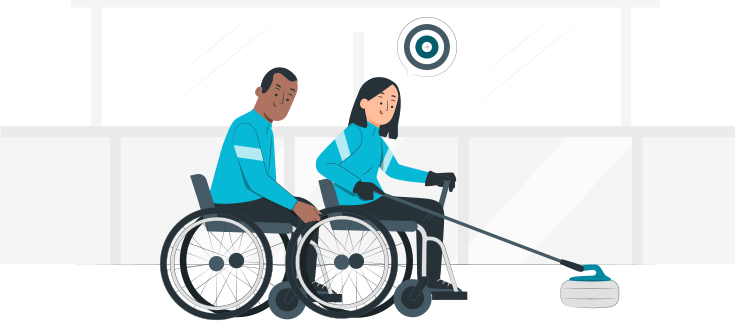
Teammates count on each other to give it their all.
Team ownership fosters individual accountability that helps change stick. Consider the very many tech transformations that fail because end users abandon new processes as inconvenient and revert to their old ways of doing things. A mindset of everyone out for themselves does change management goals no good. However, when teams establish the norms (i.e., “This is how we’re doing things now”), accountability hits close to home, and “good behavior” becomes a lot more consistent. After all, you can count on teammates to call out the “ball hogs” who jeopardize the game for everyone.
Enjoy watching Team USA compete this February and while you do, look for these lessons on teamwork to play out. Then ask yourself: are our teams equipped to lead change, or do we expect our people just to absorb it? How you answer just might be the key to bringing home an Olympics-sized organizational win.